Summary: Learn how to calculate payouts for the half-goal handicap (0.75). Split stake, push rules, and real
et's cut straight to the numbers. You bet $100 on a team with a -0.75 handicap (also written as -0.5/-1.0). The final score is 2-1 in your team's favor. Your stake is split into two equal $50 bets: one at -0.5 and one at -1.0. The -0.5 half wins outright, paying $50 times the decimal odds (say 1.90) = $95. The -1.0 half pushes because your team won by exactly one goal, so you get your $50 back. Total return: $95 + $50 = $145. Profit: $45. That's the core logic—every 0.75 handicap bet is two simultaneous wagers.Now flip the scenario. Your team loses 1-2, or draws. Both halves lose. You lose the full $100. No partial refunds. The 0.75 line is designed to reduce risk compared to a straight -1.0, but it doesn't eliminate it. I've seen bettors assume a push is guaranteed when the margin is one goal—wrong. Only the -1.0 half pushes;the -0.5 half wins. That nuance changes your payout significantly. For example, with odds of 2.00, a $100 stake on -0.75 returns $150 when winning by one goal (half at 2.00 = $100。half push = $50). Compare that to a straight -1.0 bet, which would return only your $100 stake. That's a $50 difference—not trivial.
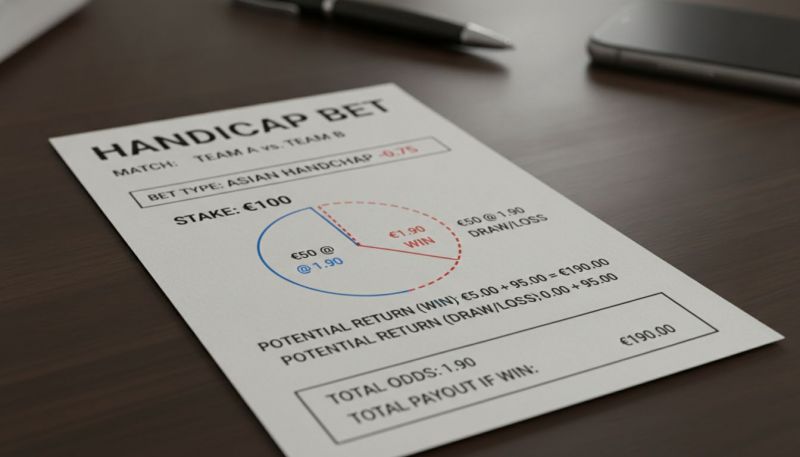
Calculating payouts for the half-goal handicap requires you to know the exact odds format. Decimal odds are easiest: multiply each half's stake by its odds. For fractional odds (e.g., 5/4), convert to decimal first: 5/4 + 1 = 2.25. Then apply the split. American odds?If you see +120, convert to decimal: (120/100) + 1 = 2.20. I always tell people to use decimal odds in their head—less room for error. Take a real match from last season: Arsenal -0.75 vs. Everton, odds 1.85. A $200 bet. Arsenal won 3-1. Half 1: $100 * 1.85 = $185. Half 2: $100 * 1.85 = $185. Total = $370. Profit = $170. If Arsenal had won 2-1, half 2 would push。giving $185 + $100 = $285. See the swing?Here's a trap many fall into: they think the 0.75 handicap always returns a partial win when the margin is one. Not true if the bet is on the underdog. Suppose you take +0.75 on the underdog, and they lose by exactly one goal. The +0.5 half loses, but the +1.0 half wins (since the bet is a push on the +1 line). So you get half your stake back. If the underdog draws or wins。both halves win. I remember a bettor who put $500 on a +0.75 underdog at odds 1.90. The underdog lost 0-1. He expected a full loss, but the payout was $250 (half stake returned) plus $0 from the losing half. He was confused until I explained the split. That's the kind of detail that separates sharp bettors from casual ones.One more practical tip: always check the house rules on pushes. Some bookmakers round the payout differently, especially for half-goal handicaps that involve a 0.75 line. In my experience。most use the exact split method, but a few offer "dead heat" rules that reduce odds instead of splitting the stake. That's rare, but it happens. For example, a bookie might pay you at half odds on the push half rather than returning the stake. That changes your return from $50 to $47.50 on a $100 bet at odds 1.90. Always read the terms. To calculate your payout quickly, use this formula: (Stake/2 * Odds) + (Stake/2 if push, or Stake/2 * Odds if win). Master this, and you'll never be caught off guard again.